When decisions need to be defended – the growing role of objective data in implant dentistry
Jun 24, 2026
In implant dentistry, documentation has always been important. Today, it is becoming decisive.
Across healthcare systems, dental records are no longer just a way to track treatment. They are a legal document – and increasingly, the foundation on which clinical decisions are evaluated. In many cases, they are also the clinician’s primary protection.
Studies and professional guidelines consistently show that comprehensive documentation plays a central role in defending clinical decisions. In fact, the majority of successful malpractice defences rely heavily on well-structured and complete patient records.
The expectation is clear: treatment choices must not only be made – they must be justified.
This shift is subtle, but significant.
It marks a move away from descriptive records towards defensible decision-making.
From recording to reasoning
Traditionally, dental records have focused on what was done:
- Diagnosis
- Treatment plan
- Procedures performed
Today, there is increasing emphasis on why it was done.
- Why was the implant loaded at that point?
- Why was healing prolonged?
- Why was a specific protocol chosen?
These are no longer theoretical questions. They are the types of questions that may arise in audits, insurance claims, or investigations.
And answering them convincingly requires more than narrative.
It requires data.
The emerging expectation: objective evidence
At the same time as documentation requirements are becoming stricter, clinical workflows are becoming more data-driven.
Digital systems now provide:
- Structured record-keeping
- Traceability of materials and devices
- Audit trails showing how decisions evolve over time
Within this landscape, reliance on subjective judgement alone is increasingly difficult to defend. Not because clinical experience is less valuable – but because it is harder to demonstrate.
This is where objective measurements become relevant.
Implant stability as a measurable parameter
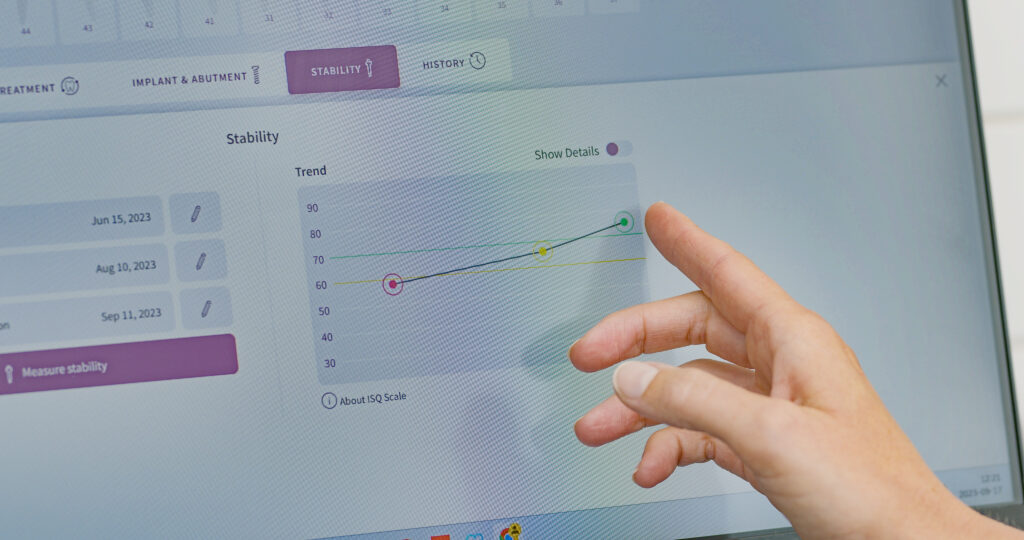
Implant stability is one of the few parameters that can be:
- Measured objectively
- Repeated over time
- Documented as part of the patient record
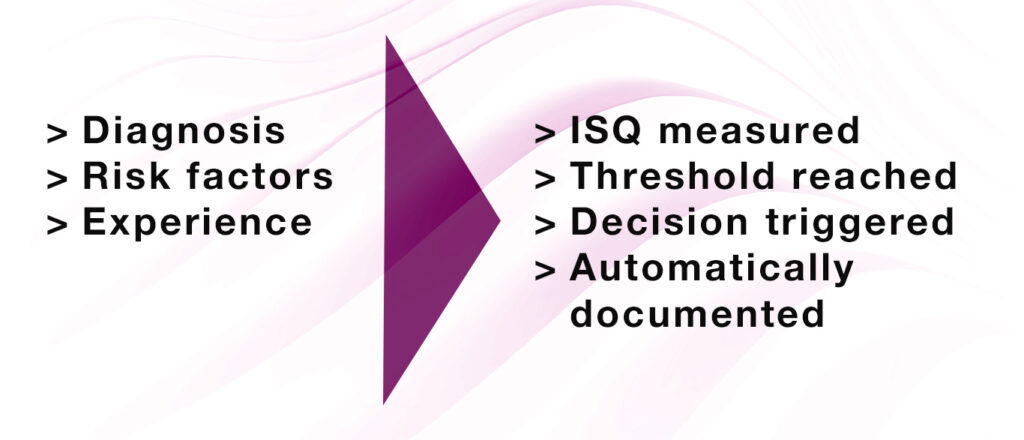
Using resonance frequency analysis, stability can be expressed as an ISQ value – providing a consistent and comparable reference point throughout the treatment workflow.
Importantly, the ISQ scale is not just a number. It is built on decades of clinical research and linked to well-established thresholds that help interpret stability and risk.
This does not replace clinical experience.
But it complements it.
It gives you something increasingly important: a measurable and evidence-based basis for decision-making.
When these measurements are recorded and followed over time, they become more than individual data points – they become a structured basis for learning, optimisation, and confidence in every decision.
A changing regulatory landscape
While requirements vary between regions, the overall direction is consistent.
Regulatory bodies are placing growing emphasis on:
- Competence and training in implantology
- Documentation and traceability
- The ability to justify clinical decisions when questioned
In some regions, specific frameworks around implant treatment are already evolving. In others, expectations are driven by insurance systems and professional standards.
Regardless of geography, the underlying trend is the same: clinical decisions are expected to be explainable, reproducible, and documented.
From data points to confidence
For clinicians, this is not about adding complexity.
It is about reducing uncertainty.
When data is collected consistently over time, it creates a clearer picture of the healing process. It allows deviations to be detected earlier. And it provides a tangible basis for decisions that might otherwise rely on intuition alone.
Perhaps most importantly, it offers something that is often overlooked:
A sense of reassurance.
Knowing that a decision is supported not only by experience, but also by objective measurement, can reduce doubt – both at the moment of treatment and afterwards.
Closing
As implant dentistry continues to evolve, the question is no longer whether data should be collected.
It is how that data can be used.
Not just to document the past – but to support decisions in the present and defend them in the future.

Add comment