Can implant stability guide treatment timing? Insights from an EAO ePoster
Oct 06, 2026
A clinical ePoster presented at the European Association for Osseointegration (EAO) explored how implant stability measurements can support treatment decisions across a wide range of clinical indications. The poster, Implant Stability Quotient (ISQ): New protocol for correct data interpretation, was authored by Stefano Trasarti and Daniela Marroni and presented data from 54 patients involving 98 implants.
Moving beyond fixed healing times
Clinicians are often faced with a familiar challenge: determining when an implant is ready for final prosthetic rehabilitation. While traditional treatment protocols frequently rely on expected healing periods, individual patients do not always follow the same biological timeline.
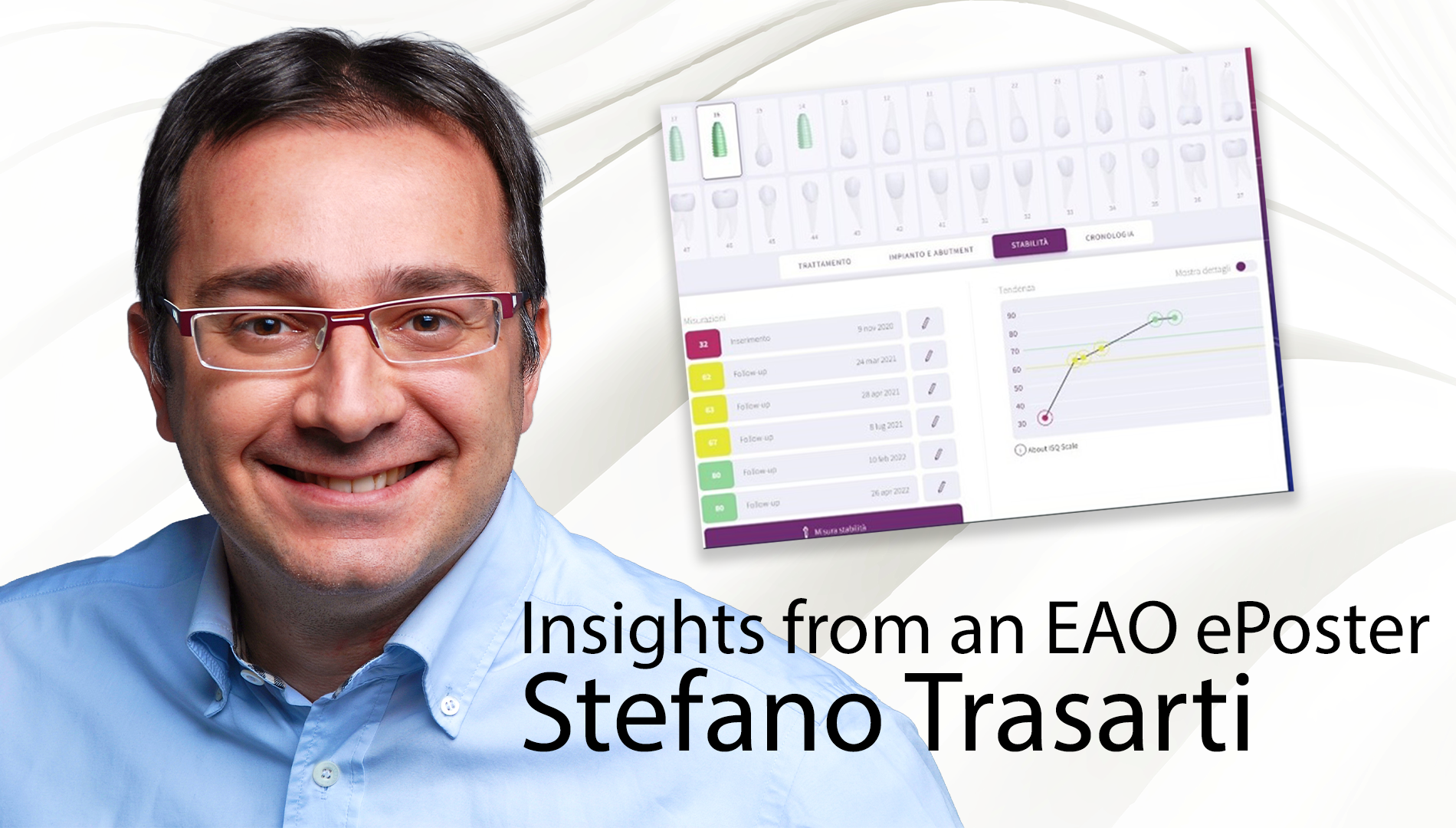
In this study, ISQ measurements were recorded at implant placement to establish a baseline and repeated throughout treatment to monitor the progression of osseointegration. All patients were followed using OsstellConnect, allowing implant stability to be tracked over time.
The authors used an ISQ value above 65 as the criterion for proceeding with definitive prosthetic rehabilitation. Cases with lower values were not loaded but continued to be monitored until implant stability had improved.
Monitoring different clinical situations
The study included a broad range of treatment indications, from implants placed in native bone to more demanding regenerative procedures, including:
- Implant placement in native bone
- Implants with exposed threads requiring augmentation
- Maxillary sinus lift procedures with less than 3 mm of residual bone
- Lateral bone augmentation using Khoury’s technique
- Complex three-dimensional bone reconstruction cases
Rather than applying a fixed rehabilitation schedule, the authors evaluated stability development over time and used the ISQ values to support clinical decision-making.
Different cases, different healing patterns
The results highlight how healing time can vary depending on the clinical situation.
In implants placed in native bone, most cases proceeded to definitive rehabilitation after approximately two months. Cases involving exposed implant threads and augmentation around the threads showed a similar pattern, with more than 70% progressing after two months.
For maxillary sinus lift procedures with less than 3 mm of residual bone, more than 70% of implants reached the rehabilitation stage after approximately five months.
In lateral bone augmentation cases, around 80% proceeded to definitive rehabilitation after four months, while approximately 65% of the complex vertical regenerative cases progressed after the same period.
The authors also noted that systemic diseases and lifestyle factors such as smoking could negatively influence osseointegration and extend rehabilitation times.
Following stability over time
One of the most compelling aspects of the poster was the use of serial ISQ measurements rather than isolated readings.
The presented cases demonstrated how stability could develop progressively during healing, allowing clinicians to observe trends over time. By performing repeated ISQ measurements throughout treatment, the clinicians were able to monitor implant stability and use that information when determining the appropriate time to proceed with rehabilitation.
This approach reflects an important principle in implant dentistry: treatment decisions should be guided not only by elapsed healing time, but also by objective information about the biological response of the implant.
Clinical takeaway
The authors concluded that ISQ monitoring is a valuable tool for achieving predictable outcomes in implant therapy. By tracking stability over time and adapting treatment decisions to the individual patient, clinicians can gain additional confidence when determining when to proceed with final rehabilitation.
Perhaps the most important message from this EAO poster is that patients do not always heal according to a predetermined timetable. Monitoring implant stability throughout the healing process may help clinicians identify when an implant is ready to move to the next stage of treatment, supporting a more individualised approach to care.
Further reading
- Read the full EAO ePoster supplement
- Download Stefano Trasarti’s ePoster (Italian language)
- Related publication by Stefano Trasarti and colleagues: Specific use of the implant stability quotient as a guide to improve healing for patients who had undergone rehabilitation with fixed implant-supported dental prostheses (2023)

Add comment